

It’s 2:00 AM, the power is out in half your house, and you smell faint burning plastic near the kitchen. You aren’t just looking for a repair—you’re looking for safety. When the microwave display flickers wildly, your immediate concern is knowing if your home is actually secure. Select the best electrical panel upgrade Highlands Ranch.
Many people assume calling an emergency electrician is only for total blackouts. According to fire safety experts, the most critical time to call is when things are still running but acting strangely. Emergency triage—the professional process of sorting immediate dangers from minor nuisances—helps you decide your exact next move.
Watch your daily appliances to spot trouble early. A microwave that dims the kitchen lights is often the first symptom of a struggling electrical panel. Waiting until morning can sometimes double repair costs as unseen heat damage spreads through your walls. Because of this risk, reliable companies use priority dispatch—sending immediate help specifically for active overheating symptoms.
Before you dial, you need to know who is arriving in the middle of the night. A reliable 24 7 electrician must possess three non-negotiable credentials: they must be fully licensed, properly insured, and clearly certified for residential work. To help evaluate your situation quickly, we rely on a basic residential electrical safety hazard checklist.
If you notice any of these specific red flags, do not attempt to open your breaker box yourself. Instead, step back and treat the situation as an immediate professional priority:
- Burning Odors: A fishy or melting plastic smell coming from any outlet or wall switch.
- Warm Plates: Switch covers or wall outlets that feel noticeably hot to the touch.
- Sparking: Visible flashes of light or loud buzzing sounds when plugging in standard devices.
- Frequent Tripping: A “safety switch” (circuit breaker) that repeatedly turns off your power to deliberately prevent a fire.
Addressing these signs early ensures your family’s safety and keeps nighttime panic at bay. By understanding what qualifies as a true hazard, you can confidently protect your home without second-guessing your instincts. Here is how to vet a trusted professional so you are never left entirely in the dark.
The 2 AM Emergency: Recognizing When a Spark Becomes a Crisis
When the lights flicker and a faint, unsettling scent drifts down the hallway at night, knowing the difference between a minor nuisance and a hidden fire hazard can quickly restore your peace of mind. Most people think 24/7 electricians are only for complete blackouts, but the most important time to call is often when your home’s power is still running but acting strangely.
Picturing how power moves through your walls reveals why things go wrong. Electricity always needs a safe “Return Path”—a dedicated wire to travel back to the source after powering your fridge or television. When that normal route gets blocked by a loose connection or damaged wire, the electricity desperately looks for a new way out. It can jump through the air to find one, creating a tiny, intense spark known as electrical arcing.
Spotting these dangerous detours usually starts with what you can see. If your hairdryer stops working and only one bathroom outlet is dead, you might just have a standard tripped safety switch. However, if half the lights in your house suddenly dim and stay that way, you are experiencing a system-wide brownout. This broad power drop means the issue is likely rooted at the main source rather than a single plugged-in appliance.
Listening closely to your walls or your main service box can also reveal hidden dangers. You generally know where your breaker box is located, but you might wonder, is a buzzing fuse box dangerous? Absolutely. While a faint, steady hum is normal for some heavy-duty meters, a loud, erratic buzzing or crackling noise means those safety switches are struggling to handle the electrical pressure, or dangerous arcing is actively happening inside.
Perhaps the most alarming warning sign is an unusual odor, which demands your immediate attention. If you are unsure what to do when an outlet smells like burning, the first step is recognizing the distinct, sharp scent of “ozone.” This chemical smell is actually the plastic insulation melting right off your wires behind the drywall. Whenever your nose picks up this harsh, fishy, or burning plastic scent near any switch, you have an active emergency.
Ignoring these sensory warnings often leads to property damage, so you need clear boundaries for when to pick up the phone. Treat the following 5 non-negotiable red flags as your cue to call a certified professional immediately:
- Burning smells: Any sharp, chemical, or melting plastic odors.
- Buzzing sounds: Crackling or loud humming from switches or boxes.
- Sparking: Visible flashes of light when plugging things in.
- Hot outlets: Wall plates that are painful or surprisingly warm to the touch.
- Partial blackouts: Half your home losing power while the rest works fine.
Experiencing any combination of these issues is one of the clearest signs your electrical panel is failing to protect your house. Rather than trying to investigate a hot wire yourself, your priority must shift to keeping your family safe while help is on the way.
Immediate Action: What to Do While You Wait for Your 24/7 Electrician
Hanging up the phone after calling a 24/7 emergency service brings a small wave of relief, but your job isn’t quite over yet. The window of time between making that call and hearing a knock on your door is a critical period for protecting your family and your property. Figuring out exactly how to handle a power outage at night—especially one caused by a localized emergency rather than a neighborhood storm—requires a calm, deliberate approach that keeps you far away from hidden hazards.
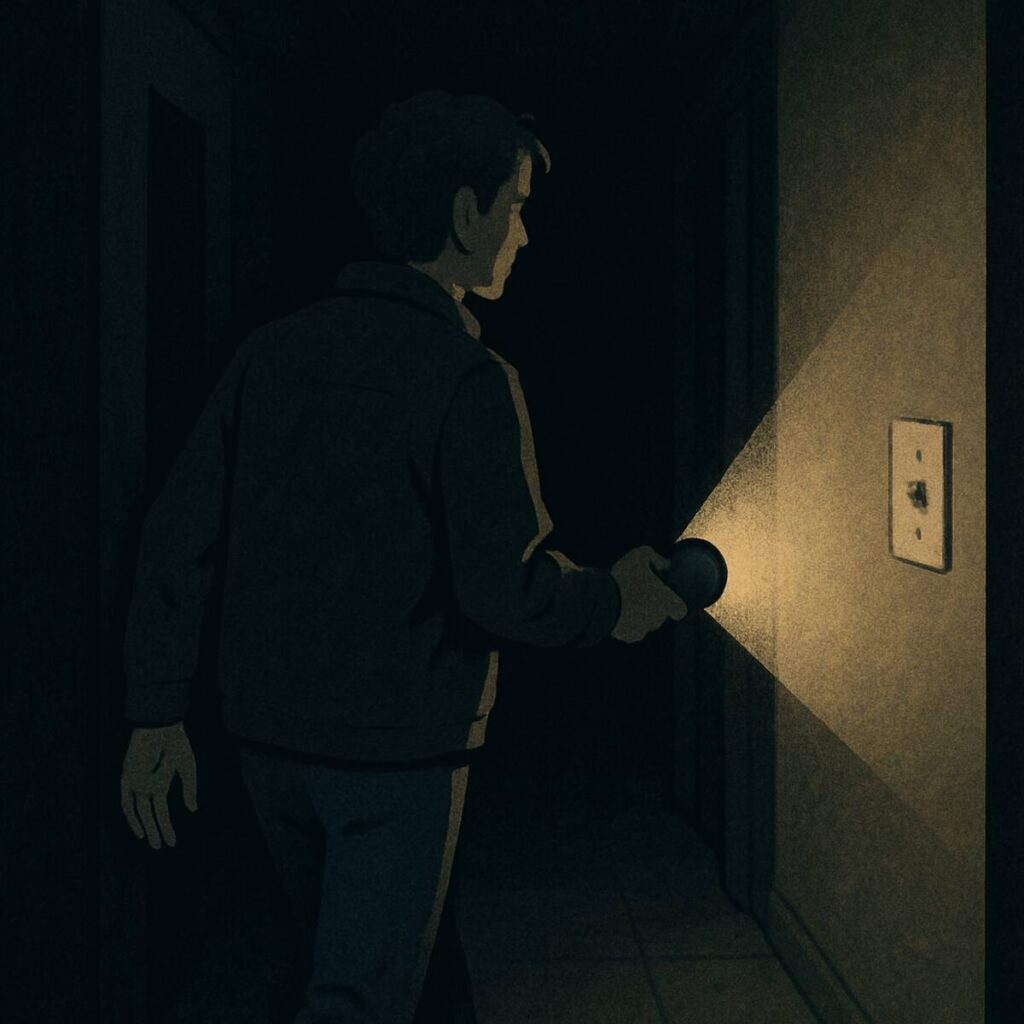
Grabbing a safe light source should always be your immediate priority. While it might be tempting to light a few candles to cut through the darkness, open flames significantly increase your risk when dealing with potential electrical faults. Preventing residential electrical fires means strictly relying on battery-powered flashlights or your smartphone’s LED to navigate, purposely avoiding the urge to flip wall switches up and down to check if the power has mysteriously returned.
Once you can see safely, it is time to practice load shedding, which is the simple act of unplugging your major devices to reduce the demand on your home’s system. Think of your home’s wiring like a water pipe; if every faucet is wide open when the water is turned back on, the sudden pressure is overwhelming. By walking through your house and unplugging the television, space heaters, and microwave, you prevent an aggressive rush of electricity from stressing the circuits the moment the technician restores your power.
Disconnecting these valuable items also protects them from surge damage, a sudden spike in electrical voltage that can instantly ruin sensitive electronics. When power rapidly rushes back into a recently repaired system, the intense burst can easily fry the delicate internal computer boards in your smart fridge, gaming console, or home office setup. Physically pulling the plug from the wall is the only guaranteed way to shield your expensive modern appliances from this destructive rebound.
If you already know where your electrical panel is located, you might consider taking one final preventative step before help arrives. While you should never attempt opening the metal casing or fiddling with individual wires, safely troubleshooting a tripped main circuit breaker often just means turning the largest, top switch to the full “off” position. Shutting off this primary gateway ensures no surprise electricity can flow into your walls while you wait, giving you ultimate peace of mind.
To keep things simple during a stressful night, follow this straightforward guide until the professional takes over:
The ‘Wait-Time’ Safety Protocol: 4 steps to secure the home
- Secure your lighting: Equip everyone with flashlights and strictly ban the use of open-flame candles.
- Isolate the area: Close the door to any specific room where you smelled smoke or saw sparks.
- Unplug the heavy lifters: Disconnect computers, TVs, and large kitchen appliances to prevent power spikes.
- Kill the main power: If you can do so safely, flip the main breaker to the “off” position to halt all current.
Taking these deliberate actions transforms you from a helpless bystander into an active protector of your home. By securing your appliances and neutralizing the immediate hazards, you ensure the technician can get straight to work diagnosing the root cause upon arrival.
The Reliability Checklist: How to Vet an Emergency Electrician in Minutes
Hearing a friendly voice on the other end of the phone at 3:00 AM is a huge relief, but your vetting process shouldn’t stop at a polite greeting. When sparks are flying or half your house is mysteriously in the dark, the urge is to hire the absolute first person who promises to drive over. However, letting an unverified worker handle your home’s main power supply can turn a manageable nighttime nuisance into a severe fire hazard. Taking just two extra minutes to confirm a few professional credentials ensures the person arriving is a qualified expert, not an enthusiastic amateur.
A critical standard to look for during this quick screening is Master Electrician status. This title isn’t just a fancy marketing word; it is a hard-earned legal designation meaning the technician has logged thousands of hours of hands-on work and passed rigorous state safety exams. Think of it like a medical specialist versus a medical student; a Master Electrician has the deep, practical knowledge required to look at a complicated, sparking panel and instantly know the safest way to shut it down. When you are paying for emergency help, you want this top-tier level of problem-solving walking through your door.
Confirming this expertise is much easier than most homeowners realize, even when you are stressed and relying on your smartphone’s cellular data. While you already know that a basic license is a legal requirement, actually taking the step to verify a license number on state databases in under 2 minutes provides ultimate peace of mind. When finding licensed emergency electrical contractors, simply ask for their state license number over the phone, type it into your local government’s website, and look for an “Active” status. If the dispatcher hesitates or claims they will “show you the paperwork later,” consider it an immediate warning sign and call someone else.
Beyond their license, the contractor must carry active General Liability insurance, which acts as a vital financial shield for your property. This specific type of coverage pays for any accidental property damage that might occur while the technician is fixing your home. For example, if a repair goes wrong and a mistake accidentally fries your expensive central air conditioning unit, the contractor’s liability insurance pays for the replacement, not your personal homeowner’s policy. You must confirm insurance coverage to protect your home from liability before you ever let a contractor touch your breaker box.
Dodging questions about insurance coverage isn’t the only warning sign to watch out for during that initial midnight phone call. Trustworthy professionals understand you are in a vulnerable spot and will communicate their basic arrival charges with absolute clarity before they dispatch a van. You can easily spot “red flag” contractors who avoid giving a clear call-out fee; if they offer vague promises like “we will figure it out when we get there,” hang up immediately. You need a transparent partner, not a financial gamble.
Location and response systems also play a massive role in securing a trustworthy partner during a crisis. Searching for a reliable electrician near me ensures the company actually operates within your community and cares about their local reputation. Furthermore, asking about the specific benefits of priority dispatch electrical assistance guarantees you are placed at the front of the line for immediate routing, rather than being squeezed into a normal daytime schedule. True emergency companies have dedicated night-shift dispatchers and GPS-tracked vans to get a vetted technician to your driveway as fast as safely possible.
To make this rapid screening process foolproof while your adrenaline is pumping, keep your questions simple and direct. Use this straightforward script when the dispatcher answers the phone:
The 4-point verification checklist for emergency contractors:
- Ask for the license: “Can you provide your state electrical license number so I can quickly verify it?”
- Confirm the status: “Will the technician arriving hold a Master Electrician status or be directly supervised by one?”
- Check the insurance: “Do you carry active General Liability insurance to protect my property during the repair?”
- Lock in the fee: “What is your exact call-out fee for an after-hours emergency dispatch?”
Checking off these four simple boxes transforms a stressful midnight scramble into a confident, informed decision. You can sit back and wait for the technician knowing your home, your appliances, and your wallet are fully protected by professional standards.
Decoding the Invoice: Understanding Emergency Call-Out Fees and Urgent Repair Costs
Staring at the ceiling at 2:00 AM while a burnt plastic smell lingers in the hallway is stressful enough without worrying about a massive bill. Most homeowners brace themselves for a severe financial hit when they realize they need immediate help. However, paying for emergency electrical repair services doesn’t mean you have to write a blank check. By understanding exactly how after-hours billing works, you can protect yourself from unfair pricing while ensuring your family’s safety.
Decoding that midnight invoice becomes much easier when you realize it is built on three basic pillars: dispatch, labor, and materials. You likely already know that electricians charge an hourly rate for their time. What surprises many people during a crisis is that the clock doesn’t always start when the physical repair begins. Emergency billing structures shift the focus toward immediate availability, meaning you are paying a premium just to get an expert to drop everything and prioritize your home over their sleep.
The most noticeable difference on your bill will be the dispatch fee, which is a flat rate charged simply to get the technician to your front door. Companies use this to cover the logistical nightmare of waking a licensed professional, paying them night-shift rates, and sending a fully stocked van into the dark. Furthermore, many contractors use zone-based pricing, meaning this fee adjusts based on how many miles they have to drive to reach your neighborhood. Always ask exactly what these after-hours electrician call out fees cover, as honest companies will tell you if this initial charge includes the first hour of diagnostic work or just the travel itself.
Once the van is safely in your driveway, the actual repair work begins under a different pricing model than a standard Tuesday afternoon appointment. The cost difference between standard and urgent repairs usually comes down to “time and a half” or even double the normal hourly labor rate. Think of it like paying for an express lane ticket; you are investing in the speed and immediate attention required to stop a dangerous spark before it escalates. While the parts they use—like a new wire or outlet—cost the same day or night, the expertise required to safely handle live, unpredictable voltage in the dark justifies the higher labor premium.
Knowing the average costs ahead of time acts as a powerful shield against potential price gouging. While local rates vary based on your city and the severity of the damage, a fair emergency invoice typically falls into these common emergency repair price ranges:
- Emergency Call-Out Fee: $150 to $300 (often covers travel and the initial safety diagnostic).
- Standard Breaker Replacement: $150 to $250 (includes the physical part and the urgent labor to install it safely).
- Complex Fault Finding: $200 to $400+ (locating hidden, dangerous wiring issues behind your walls or inside a sparking panel).
Paying a few hundred dollars unexpectedly is never fun, but looking at the return on investment changes the perspective entirely. If your refrigerator stops humming during a summer storm because of a failing circuit, paying for a rapid repair saves hundreds of dollars in spoiled groceries. More importantly, fixing a loose, overheating wire at 3:00 AM prevents a major electrical fire that could destroy your home or force a total system replacement. That midnight invoice is fundamentally an investment in preserving your most expensive household appliances and securing your family’s peace of mind.
Taking control of these costs requires asking clear questions over the phone before the dispatcher ever sends a van. Confirm the base arrival charge and ask for their emergency hourly rate upfront so there are no devastating surprises when the job is done. A trustworthy professional will gladly outline their pricing structure, proving they value transparency just as much as safety.
Troubleshooting Before You Call: Is it a Tripped Breaker or a Total Failure?
Most people assume a sudden loss of power in the middle of the night automatically requires an expensive emergency dispatch. In reality, the most important time to pause and assess the situation is when the lights first go out, as the solution might be completely free. Before you pick up the phone, a few safe, basic checks can quickly reveal whether you are facing a dangerous fault or just a sensitive safety mechanism doing its job perfectly.
Your very first step is to look out the window to determine if you are dealing with a grid vs. local failure. A grid failure means the utility company’s equipment has lost power, affecting streetlights and neighboring homes, which is an issue a private electrician cannot fix for you. Conversely, a local failure means your neighbors are fully illuminated while your home sits in the dark. If the outage is completely isolated to your property, the issue lives inside your walls, and it is time to start safely investigating.
Often, the root cause is a single faulty appliance asking for too much power all at once. Think of your electrical system like water pipes; if too many heavy-duty devices, like a space heater and a hairdryer, turn on simultaneously, the “pressure” drops and the system shuts down to protect itself. If the outage happened the exact moment you plugged something in, immediately unplug that specific device. Removing the heavy load is essential before you attempt to restore power, otherwise the system will just shut down again.
Even if your larger appliances are innocent, the answer might be hiding right on your kitchen or bathroom wall in the form of a GFCI. A Ground Fault Circuit Interrupter (GFCI) is a specialized outlet with “Test” and “Reset” buttons designed to act as a localized safety switch, instantly cutting power if it detects moisture or an unstable connection. Because multiple standard outlets are often wired “downstream” from a single GFCI, a tripped button in the bathroom can mysteriously kill power to the hallway lights. Firmly pressing the “Reset” button on these specific outlets can often bring a whole section of your house back to life in seconds.
When both the appliances and wall outlets check out fine, you can move to your main breaker box using this ‘Safe DIY’ 3-step troubleshooting sequence:
- Visual Inspection: Open the outer metal door of the panel—without ever unscrewing the protective inner cover—and look for any switches that have snapped into the middle, “neutral” position.
- The 2-Step Reset: To reset a tripped switch, you must first push it firmly all the way into the “Off” position until you feel a click, and then solidly push it back to “On.”
- The 15-Minute Rule: If the switch trips again immediately or within fifteen minutes, do not attempt to reset it a third time, as this indicates a persistent, dangerous fault.
Understanding where to draw the line between a simple reset and a professional dispatch is exactly why you shouldn’t DIY emergency electrical work beyond these surface-level checks. Your breaker is physically stopping a fire from starting; repeatedly forcing it back on removes that vital protection. Furthermore, any visual signs of damage, such as smoke, buzzing sounds, or the need for an immediate response for sparking light switches, require you to step away entirely. Touching exposed wires or opening the inner casing of a panel exposes you to lethal voltage that only a licensed, insured professional should ever handle.
Ultimately, if you find yourself constantly troubleshooting a tripped main circuit breaker, your electrical system is practically begging for help. A main breaker that refuses to stay on means your home is routinely drawing more electricity than the foundational wiring was built to safely carry, signaling the need for permanent panel upgrades.
Long-Term Protection: Upgrading Your Electrical Panel to Prevent Future Emergencies
Most people think their electrical system is a permanent fixture, silently working behind the walls forever. In reality, the breaker box is a hardworking machine that ages just like a roof or a water heater. As we plug in more technology over the decades, older panels simply cannot keep up with the constant demand, quietly creating hidden risks behind closed metal doors.
Adding a new electric vehicle (EV) charger to the garage or upgrading to a heavy-duty HVAC system completely changes how your house uses energy. Professionals perform a load calculation—a strict budget for your home’s electricity—to determine safe capacity. If your new appliances ask for more power than the main line can supply, the entire system becomes strained, leading to frustrating outages and compromised safety.
Recognizing the signs your electrical panel is failing is the best way to stop an emergency before it starts. There are three major red flags indicating your equipment is nearing its 25-year lifespan: breakers that frequently trip, a faint burning smell near the metal box, or lights that constantly dim when the refrigerator kicks on. Ignoring these warnings pushes outdated hardware past its safe breaking point.
Rather than waiting for a midnight failure, the smartest preventative step is scheduling a professional electrical safety audit. During this thorough inspection, licensed electricians look for tiny gaps or loose wires where electricity struggles to jump across the connection. This jumping is called arcing, and it creates intense, invisible heat that slowly melts protective wiring insulation right inside your walls.
Modern audits even use specialized infrared thermometers to safely look for hot spots without touching a single wire. This thermal scanning is especially critical when restoring power after severe weather damage, as power surges from heavy storms can secretly weaken vital connections. Identifying these heated stress points early allows a professional to tighten or replace parts before a catastrophic meltdown occurs.
To keep your system running smoothly year-round, you can follow a straightforward residential electrical safety hazard checklist. This simple annual maintenance checklist for a crisis-free home includes:
- Testing all GFCI buttons in your kitchen and bathrooms to ensure the safety switches still pop out.
- Checking visible appliance cords for cracks, fraying, or scorch marks.
- Ensuring no furniture or storage boxes are blocking access to your main breaker box.
- Listening closely for any unusual buzzing sounds near heavily used light switches.
Taking control of your home’s infrastructure transforms electrical maintenance from a terrifying mystery into a predictable, manageable routine. By understanding your home’s energy budget and knowing when to call a licensed professional for an upgrade, you protect both your property and your family from sudden outages.
Your 3-Step Plan for Electrical Peace of Mind
You now have the vocabulary to identify when a tripped breaker is acting as a vital safety switch and the confidence to vet an emergency electrician effectively. By knowing exactly how to ask about their licensing, insurance, and upfront diagnostic fees, you can take control of an unpredictable situation before the professional even arrives at your door.
Do not wait until your home loses power in the middle of a storm to start scrolling through search results for help. Take five minutes right now to find a reputable local 24/7 electrician and verify their credentials while the lights are still on. Create an emergency electrical contact card with their direct number and keep it taped securely to your refrigerator or the front of your breaker box. Having this vetted professional saved in your phone ahead of time transforms a midnight panic into a highly manageable resolution.
You can protect your home even further by actively looking for early warning signs before they escalate. Implement a simple five-minute monthly safety walk-through using a residential electrical safety hazard checklist to gently test for warm outlets, listen for buzzing switches, and note any dimming lights when appliances run. During these routine checks, make a firm household commitment to the “Never DIY” rule for internal wiring safety. Remember that while flipping a breaker switch is perfectly safe, anything involving exposed wires or opening panels must always be left to the experts.
Understanding how your home manages power changes the way you address a late-night electrical issue. Equipped to recognize the crucial safety signals your house is trying to send you, you can secure your foundation confidently. Start with the simple step of saving a trusted contact today, and notice how much more secure you feel the next time a severe storm rolls in. By respecting the boundaries of electricity and having a qualified expert on standby, you guarantee your family’s safety around the clock.
