

Every pickup truck owner eventually faces the same dilemma: how to best protect, utilize, and secure their truck bed. Leaving the bed open exposes your cargo to the elements, invites theft, and creates aerodynamic drag that compromises your fuel efficiency. The solution is simple in concept but complex in execution—installing a premium bed cover. However, with the market flooded with endless styles, materials, and configurations, finding the perfect match for your specific lifestyle requires careful consideration. Find the best tonneau cover.
Currently, the most heated debate in the truck accessory world centers around the Tri-Fold vs Flipback Quad-Fold Tonneau Cover. Both styles offer exceptional utility, but their mechanical differences dictate how you interact with your truck on a daily basis.
Whether you are a weekend warrior hauling dirt bikes, a contractor carrying expensive tools, or a family using the truck for cross-country road trips, understanding the nuances between these two popular designs is critical. In this comprehensive guide, we will break down the mechanics, aesthetics, security, and practicality of both options to help you determine which belongs on your rig.
Understanding the Folding Tonneau Cover Landscape
Before diving into the specifics of tri-fold and quad-fold designs, it is important to understand why folding covers dominate the market when searching for the best tonneau covers. Unlike one-piece fiberglass lids that are heavy and restrictive, or rolling covers that can take up valuable canister space near the bulkhead, folding covers strike the perfect balance. They offer structural rigidity, ease of use, and quick partial or full access to your truck bed.
When exploring the market, you will immediately encounter the debate of hard folding vs soft folding truck covers.
- Soft Folding Covers: These typically feature a vinyl tarp stretched over an aluminum frame. They are lightweight, budget-friendly, and easy to remove. However, they lack robust security—a sharp knife is all it takes to bypass them.
- Hard Folding Covers: Constructed from fiberglass, rugged polymers, or aluminum, these are the premium standard. They offer superior security, bear substantial top weight, and look incredibly sharp.
For the purposes of this deep dive, we will primarily focus on hard-folding models, as this is where the mechanical differences between tri-fold and quad-fold designs most directly impact daily utility.
The Tri-Fold Tonneau Cover: The Industry Standard
The tri-fold cover is the undisputed veteran of the truck bed accessory world. As the name suggests, the cover is divided into three equal-sized panels hinged together. To open it, you unlatch the panel nearest the tailgate and fold it over the middle panel. You can then fold those two panels over the final third nearest the cab, securing them in place with built-in buckles.
Mechanics and Daily Use
The tri-fold design is renowned for its simplicity. The hinges are robust, and the folding process takes mere seconds. Because it only has three panels, the individual sections are wider. This means fewer hinges and fewer potential points for water intrusion.
However, the tri-fold has one primary limitation: when fully open and buckled down, the final third of the cover remains flat over the front of your truck bed (near the cab). If you need to haul a large appliance, an ATV, or tall furniture, you have two choices. You must either slide the item under the stationary front panel (which limits the height of the cargo you can push all the way forward) or physically remove the entire cover from the truck. While removal is usually tool-less and straightforward, it is an extra step that requires you to store the heavy cover in your garage.
Pros of the Tri-Fold Design
- Simplicity and Reliability: Fewer moving parts mean a longer lifespan and less maintenance.
- Cost-Effective: Generally, tri-folds are less expensive to manufacture than quad-folds.
- Ease of Removal: Most hard tri-folds can be completely detached from the bed rails in under five minutes.
- Fewer Seams: Three large panels equate to only two folding seams, reducing the likelihood of water seeping through during a rainstorm.
Cons of the Tri-Fold Design
- Restricted Bed Access: You lose top-down access to the front third of your truck bed unless you remove the cover entirely.
- Bulkier Folds: Because the panels are wider, the folded stack sits higher off the bed rails, which can slightly obscure the view directly out the back window.
The Flipback Quad-Fold Tonneau Cover: Maximum Utility
The flipback quad-fold cover represents the evolution of the folding design. It typically consists of either four equal panels or three standard panels and one smaller “hinge” panel near the bulkhead.
The primary difference becomes apparent when you fold it all the way open. Instead of remaining flat over the front third of the bed, the final panel features a specialized hinge mechanism that allows the entire stacked cover to flip up completely vertically, resting against the back of the truck cab. Support struts or prop rods then lock the vertical stack safely in place.
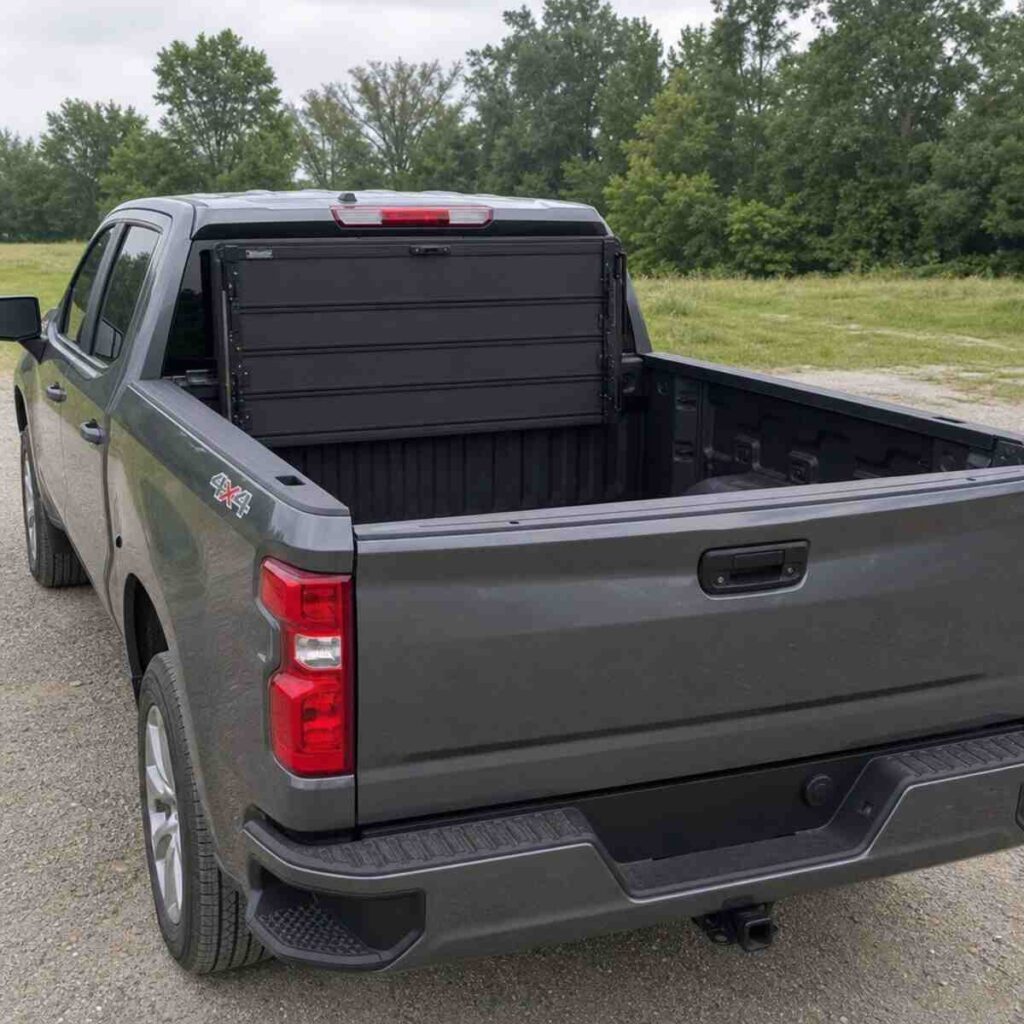
Mechanics and Daily Use
The defining characteristic of this style brings us to the immense benefits of the full-bed access tonneau cover. Because the cover flips entirely out of the way, you gain 98% to 100% access to your truck bed without ever having to unclamp or remove the heavy unit. You can load a refrigerator, a stack of lumber, or a motorcycle right up to the bulkhead.
When comparing truck bed cover folding mechanisms, the quad-fold’s vertical flip design is an engineering marvel. However, it does come with specific quirks. When the cover is propped up against the cab, it rests against rubber bumpers to protect your truck’s paint.
Pros of the Flipback Quad-Fold Design
- 100% Bed Access: Unrestricted use of your truck bed without the hassle of removing the cover.
- Versatility: You can drive with it closed, partially open, or fully flipped up.
- Modern Engineering: Often built with premium components, specialized prop rods, and advanced latching systems.
Cons of the Flipback Quad-Fold Design
- Cab Contact: Although the cab is protected by rubber bumpers, some truck owners are uncomfortable with heavy panels leaning against it.
- Higher Price Point: The advanced hinges, prop rods, and additional panels increase manufacturing costs.
- Rear Window Obstruction: When flipped vertically, the panels block the rear cab window.
This brings up a common and critical question: can you drive with a quad-fold cover open? The answer is yes. Manufacturers explicitly design these covers with rigid prop rods and secure buckles so they can be driven at highway speeds while flipped up vertically. However, you must be comfortable relying solely on your side mirrors, as your rear-view mirror will be completely blocked.
The Head-to-Head: Tri-Fold vs Flipback Quad-Fold Tonneau Cover
When executing a thorough tonneau cover comparison, evaluating how these two designs stack up against one another in specific categories is essential. Your choice will ultimately depend on how you prioritize access, visibility, and budget.
1. Bed Access
Winner: Flipback Quad-Fold If you frequently haul bulky items—like dirt bikes, pallets of sod, or large furniture—the quad-fold is the undisputed champion. The ability to utilize the entire length of your truck bed without pulling out wrenches or recruiting a friend to help you lift a heavy cover off the truck is a game-changer. The tri-fold will always leave the front third of your bed covered, forcing you to play Tetris with your cargo.
2. Rear Window Visibility
Winner: Tri-Fold. Let’s discuss rear-window visibility with the panels folded. When a tri-fold is fully open (folded flat and buckled), it sits a few inches high on the bed rails. You can still see clearly out of your rear window, allowing for safe reversing and easy monitoring of your trailer. Conversely, when a flipback quad-fold is fully open, your rear window is completely blacked out. If you tow frequently or navigate tight job sites where the rear-view mirror is essential, the vertical quad-fold can present a visibility challenge.
3. Aesthetics and Profile
Winner: Tie (Depending on Brand) Modern truck owners highly value low profile bed cover aesthetics. Nobody wants a bulky, cheap-looking tarp sitting three inches above their bed rails. Today, both premium tri-folds and quad-folds offer ultra-low-profile designs that sit flush inside the bed rails, creating a sleek, aerodynamic look. The choice here comes down to the specific brand and model rather than the folding style itself.
4. Weather Resistance
Winner: Tri-Fold (By a narrow margin) Both styles utilize automotive-grade EPDM rubber seals and integrated water drain tubes to channel water away from your cargo. However, from a pure physics standpoint, every hinge is a potential point of water entry. Because a tri-fold has fewer panels (and therefore fewer hinges), there are fewer seams for rain and snow to penetrate. That said, a high-quality quad-fold will still keep 99% of the elements out.
5. Price and Value
Winner: Tri-Fold When evaluating your budget, you will likely ask yourself: is a quad fold cover worth the extra cost? Quad-folds typically command a premium—often costing $200 to $400 more than an equivalent quality tri-fold due to the extra panel, complex hinges, and prop-rod mechanisms. If you rarely haul items taller than your bed rails, the extra cost of a quad-fold may not be justified. The tri-fold remains the value champion.
Key Considerations: How to Choose a Folding Truck Bed Cover
Understanding the difference between the folding mechanisms is only step one. When you are ready to pull the trigger, you must evaluate several other critical features. Knowing how to choose a folding truck bed cover requires looking beyond the hinges to the materials, security, and load-bearing capabilities.
Material Construction: The Aluminum Advantage
When shopping for a hard folding cover, you will generally choose between fiberglass, polymer/ABS plastics, and aluminum. For the best combination of weight, durability, and aesthetics, seek out heavy duty aluminum panel construction.
Aluminum panels—often filled with a high-density foam core—offer unparalleled structural rigidity without adding excessive weight to your truck. These panels provide brilliant impact-resistant truck bed protection. Whether you are dealing with a severe hailstorm or accidentally drop a heavy wrench from the roof of your cab, premium aluminum panels will resist denting and puncturing far better than vinyl or thin plastics. Furthermore, aluminum is naturally rust-resistant, ensuring your cover looks pristine for years, even in coastal or heavily salted winter environments.
Security: Protecting Your Livelihood
A truck bed cover is only as good as its ability to keep thieves out. If you carry expensive tools, golf clubs, or camping gear, locking mechanism security features should be a top priority.
Most modern hard folding covers latch securely to the inside lip of the bed rails. The beauty of this design is that the cover cannot be opened while the tailgate is closed and locked. If your truck is equipped with a locking tailgate (especially one tied to your key fob), your truck bed effectively becomes a massive, impenetrable steel safe.
Look for covers that feature:
- Dual-sided slam latches (automatically locking when you drop the panel).
- Pull-cable releases hidden securely under the panels.
- Aluminum extrusions that cannot be easily pried up with a crowbar.
Weight Capacity Limitations
Depending on your lifestyle, you may occasionally need to place items on top of your cover. This brings us to truck bed weight capacity considerations.
A soft vinyl cover cannot support any weight—a heavy snowfall can stretch and ruin it. Hard folding covers, however, are engineered to bear loads. A high-quality aluminum tri-fold or quad-fold can typically support between 300 to 400 pounds of evenly distributed weight. This is perfect for heavy snow loads or strapping down lightweight, bulky items (like foam insulation boards or a lightweight kayak) to the top of the cover. However, you must never concentrate weight—standing in the middle of a panel will likely cause it to dent or bow. Always verify the manufacturer’s weight rating before loading the top of your cover.
Storage Optimization
One of the hidden benefits of a bed cover is maximizing truck bed storage space. Without a cover, everything you put in the bed must be strapped down, placed in weather-tight bins, or secured against theft.
With a hard folding cover, the entire bed becomes a usable trunk. You can utilize bed dividers, sliding cargo trays, or swing-out toolboxes near the tailgate. Because the cover protects the interior, you no longer need to rely on bulky, waterproof Pelican cases for everything; you can confidently use standard cardboard boxes, duffel bags, and open crates, drastically maximizing the usable volume of your bed.
Installation Guide: Setting Up Your Truck Bed Cover
A major selling point of modern folding covers is the ease of installation. Gone are the days when installing a bed accessory required permanently altering your vehicle. If you are handy with basic tools, a DIY tonneau cover installation will save you the expensive hourly rate of a custom truck shop.
Here is a comprehensive no-drill tonneau cover installation guide that applies generally to both tri-fold and flipback quad-fold systems:
Step 1: Prep and Clean
Start by thoroughly washing the bed rails and the bulkhead (the front wall of the bed behind the cab). Ensure the surface is completely dry. If you have a drop-in plastic bed liner, you may need to trim small notches where the clamps will sit. Spray-in bed liners generally do not require any modifications.
Step 2: Apply the Weather Stripping
Most trucks have a bulkhead that sits slightly lower than the side bed rails. To prevent water from rushing into the front of the bed, manufacturers include a roll of foam weather stripping. Apply this strip evenly across the bulkhead, ensuring it aligns perfectly with the height of the side rails.
Step 3: Mount the Rails (If Applicable)
While some budget tri-folds clamp directly to the truck’s existing bed lips, premium flush-mount covers require the installation of specialized aluminum rails.
- Hold the provided rail flush against the inside lip of your truck’s bed.
- Using the provided aluminum C-clamps, secure the rail to the truck bed. Usually, three clamps per side are required (front, middle, and rear).
- Hand-tighten the clamps first to ensure the rail is level, then torque them down using a socket wrench (usually 1/2-inch or 13mm). Do not overtighten, as you could warp the rail.
Step 4: Position the Cover
With a friend’s help, carefully lift the folded cover assembly onto the rails near the bulkhead.
- For a flipback quad-fold, attach the elevator bolts through the front mounting panel into the brackets on the rails.
- For a standard tri-fold, attach the front hand-tightened clamps to the bed lip or the installed rail.
Step 5: Test the Folding Mechanism and Alignment
Before locking everything down permanently, unfold the cover completely towards the tailgate. Check the alignment. The cover should sit squarely between the rails and overlap the tailgate by just a fraction of an inch to create a watertight seal. If it is crooked, fold it back up, loosen the front mounts slightly, adjust, and re-tighten.
Step 6: Route the Drain Tubes
Premium covers feature water catchment channels in the rails. Attach the included plastic drain tubes to the spouts at the front of the rails. Route the other end of the tubes through the factory drain holes located at the front of your truck bed (near the floor). This step is crucial for keeping your cargo dry.
Step 7: Final Check
Close your tailgate, fold the cover down completely, and ensure the rear slam latches engage securely with a satisfying click. Test the pull cables to ensure they release smoothly.
Maintenance and Longevity
To ensure your investment lasts the lifetime of your truck, routine maintenance is required. Hard folding covers endure brutal conditions: scorching UV rays, freezing ice, road salt, and constant vibrations.
- Keep the Seals Clean: The EPDM rubber seals are the unsung heroes of your cover. Wipe them down monthly with a damp cloth to remove abrasive dirt and sand. Twice a year, apply a dedicated rubber protectant (avoid silicone-based products that can degrade rubber over time) to keep the seals supple and prevent cracking.
- Lubricate the Hinges and Latches: The aluminum hinges and the slam latches at the rear of the cover can become sticky due to dust buildup. Every few months, spray a dry PTFE (Teflon) lubricant into the latching mechanisms and along the hinges. Avoid wet lubricants like standard WD-40, as they will attract and hold onto dust.
- Clear the Drain Tubes: If you park under trees, pine needles and leaves can quickly clog the rail gutters and drain tubes. Periodically pour a small cup of water into the rail gutter; if it doesn’t immediately drain out the bottom of the truck, use an air compressor to gently blow out the tubes.
- Wash Regularly: Clean the top of your cover with standard automotive car wash soap. Avoid harsh detergents or industrial degreasers, which can strip the UV-resistant coating from the aluminum or polymer panels.
Practical Applications: Matching the Cover to Your Lifestyle
To truly decide between a tri-fold and a flipback quad-fold, it helps to look at real-world applications. How you use your truck will dictate which cover provides the most frictionless experience.
The Overlander and Outdoor Enthusiast
If you spend your weekends hiking, fishing, or off-roading, weatherproofing truck bed for camping gear is non-negotiable. Sleeping bags, tents, firewood, and expensive coolers need to be protected from sudden downpours and dust on dirt trails.
- The Verdict: Both covers excel here. However, if you also carry a tall dirt bike or a bulky kayak on the weekends, the flipback quad-fold is the superior choice. You can flip the cover up to load the bike, tie it down securely, and hit the road. With a tri-fold, you would have to completely unclamp and remove the cover to fit the motorcycle tire against the bulkhead, leaving your cover sitting awkwardly in the garage.
The General Contractor
Contractors live out of their truck beds. They haul heavy tools, power washers, compressors, and long pieces of lumber. For this demographic, impact-resistant truck bed protection and security are paramount. Tools left in an open bed invite theft.
- The Verdict: The flipback quad-fold shines brightly on the job site. The ability to instantly flip the cover up to access a large generator or to load a pallet of bricks right behind the cab with a forklift makes the quad-fold a valuable asset. The heavy-duty aluminum construction ensures that accidentally dropping a hammer on the cover won’t ruin its integrity.
The Family Hauler and Daily Commuter
Many modern trucks are used as family vehicles. They are used for grocery runs, taking kids to sports practice, hauling luggage for road trips, and doing the occasional weekend home improvement project.
- The Verdict: The tri-fold cover is often the perfect match for the daily commuter. It provides excellent security for strollers, groceries, and luggage. The ease of flipping just the rear panel open to grab a few grocery bags makes daily life highly convenient. Since the commuter rarely hauls large ATVs or pallets of heavy materials, the loss of front-bed access is not an issue. Furthermore, retaining clear rear-view mirror visibility is a major plus for daily driving in heavy traffic. The savings from choosing a tri-fold over a quad-fold can then be spent on other accessories, like a bed mat or a set of quality floor liners.
Frequently Asked Questions
To wrap up this ultimate guide, let’s address some of the most common questions truck owners have when navigating the folding cover market.
Do folding tonneau covers actually improve gas mileage?
Yes, though the savings are modest. An open truck bed acts like a parachute, catching wind against the closed tailgate and creating aerodynamic drag. By covering the bed, air flows smoothly over the top of the truck. Most aerodynamic studies (including those conducted by wind tunnels and independent testers) show a fuel efficiency improvement of about 5% to 8% at highway speeds. Over the lifespan of a truck, a cover can essentially pay for itself in fuel savings.
Can I take my truck through an automatic car wash with a folding cover installed?
Yes, high-quality hard folding covers constructed of aluminum or tough composites can easily withstand the brushes and high-pressure jets of a touchless or friction automatic car wash. However, soft folding covers with vinyl tarps should avoid friction washes, as the harsh brushes can scuff the vinyl and eventually cause micro-tears.
Are flipback quad-fold covers difficult for one person to operate?
Not at all. Despite being made of heavy-duty materials, the panels’ weight is evenly distributed as you fold them over one another. Flipping the final stack vertically against the cab requires a slight lift, but the hinges do most of the work. Almost anyone can operate a hard folding cover single-handedly in under 30 seconds.
Will a tonneau cover make my truck bed 100% waterproof?
No cover is perfectly waterproof. It is best to think of them as highly weather-resistant. While the top panels and rubber seals will deflect rain and snow, the truck bed itself is not a sealed environment. Water can occasionally splash up through the gaps around the tailgate perimeter or through the stake pocket holes. However, for 99% of situations, a properly installed cover with functioning drain tubes will keep your camping gear, luggage, and tools perfectly dry.
Final Thoughts: Making the Right Investment
The journey of outfitting your pickup truck is highly personal. The bed of your truck is a blank canvas, and how you cover it dictates how you interact with your vehicle every single day.
When weighing the Tri-Fold vs Flipback Quad-Fold Tonneau Cover debate, there is no universally right or wrong answer—only the answer that fits your specific needs.
If you prioritize simplicity, unobstructed rear window visibility, superior weather resistance due to fewer hinges, and exceptional value for your dollar, the classic tri-fold cover remains an unbeatable option. It is the gold standard for daily commuters, family haulers, and light-duty weekend warriors.
If, however, your truck is a workhorse, an overland adventure rig, or a heavy-duty hauler, the flipback quad-fold cover is the pinnacle of truck bed evolution. The ability to achieve 100% full bed access at a moment’s notice, allowing you to load tall items without wrestling a heavy cover off the truck, is a luxury that quickly becomes a necessity.
Whichever path you choose, prioritise heavy-duty aluminium panel construction for longevity, ensure robust locking mechanism security features to protect your valuables, and follow a careful no-drill tonneau cover installation guide to guarantee a watertight, flush fit.
A premium hard folding tonneau cover is more than just a stylistic upgrade; it is an investment in your truck’s utility, security, and efficiency. Choose the design that aligns with your lifestyle, and unlock the true potential of your pickup truck.
